
Nuvvuagittuq Faux Amphibolite Garnet [152 g ~ 4.3 Ga]
Brand : Jensan Scientifics LLC
- SKU:
- JPT-87189
- Condition:
- New
- Availability:
- Usually ships in 24 hours.
- Weight:
- 1.00 LBS
- Minimum Purchase:
- 1 unit
- Maximum Purchase:
- 1 unit
- Shipping:
- Calculated at Checkout


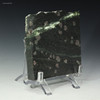



Nuvvuagittuq Faux Amphibolite with Garnets
This faux amphibolite garnet specimen came from Porpoise Cove in the Nuvvuagittuq Supracrustal Belt of northern Quebec, a leading candidate for the oldest rock formation on Earth. Its face is crowded with deep red to reddish-brown garnets set in a grayish-beige matrix, in crust thought to be about 4.3 Ga.
About This Hadean Faux Amphibolite
- What it is: A garnet paragneiss, a metamorphic rock that was buried, heated, and squeezed in Earth's earliest crust. Garnets grew throughout it during that heat and pressure.
- Packed with garnets: In places, garnets make up roughly half of this rock, which gives the smooth face its bold, speckled look.
- Why "faux amphibolite": Geologists use this nickname because the rock looks like ordinary amphibolite, but its main dark mineral is cummingtonite instead of the usual hornblende.
- Where it came from: Porpoise Cove, on the eastern shore of Hudson Bay near the Inuit village of Inukjuak, Nunavik, Quebec.
- Why it matters: Nuvvuagittuq is the only known rock formation thought to date from the Hadean, Earth's first 500 million years. Almost all other crust from that time was destroyed.
- The age evidence: A 2008 study dated these rocks to about 4.3 billion years, or 4.3 Ga. A 2025 study showed that younger rocks cutting through them are at least 4.16 billion years old, so the host rock is still older.
- Collected long ago: This specimen was professionally and legally collected in the early 2000s. The site is now closed to collecting, so very little new material will reach the market.
Product Information
| Specimen | Nuvvuagittuq Faux Amphibolite with Garnets |
| Material | Garnet-bearing paragneiss ("faux amphibolite"), diamond lap-polished front face with natural rough back, no fractures or repairs |
| Locality | Porpoise Cove, Nuvvuagittuq Supracrustal Belt, Nunavik, Quebec, Canada |
| Geologic Age | ~ 4.3 Ga (Hadean) |
| Dimensions and Weight | 82 mm L x 77 mm W x 11 mm D, 152 grams |
| Photographic Notes | Shown lightly sprayed to reveal components and texture. |
| Science Gift Options | An extraordinary gift for collectors of Earth's oldest rocks, geology enthusiasts, science educators, and museum or institutional displays |
| What's Included | Certificate of Authenticity (COA), information sheet, specimen tag, tag stand, specimen stand, XRF analysis. The brass scale cube is shown for size reference only and is not included. |
| Legality | Professionally and legally collected in the early 2000s |
| Provenance | All of our material is proprietary and sourced from scientists and/or verified scientific estate collections, backed by the included Certificate of Authenticity. |
| SKU | JPT-87189 |
| Availability | ONLY 1 AVAILABLE |
Images professionally photographed under controlled studio lighting using Zeiss optics and a pro-grade Canon camera, for guaranteed accuracy. The brass scale cube measures 1 cm per side.
Rarity and Significance
| Scientific Significance | ★★★★★ |
| Locality Uniqueness | ★★★★★ |
| Rarity | ★★★★★ |
| Market Availability | ½☆☆☆☆ |
| Historical Importance | ★★★★☆ |
| Display Appeal | ★★★★★ |
Questions Commonly Asked About Nuvvuagittuq Faux Amphibolite
How old is this specimen?
About 4.3 billion years. Earth is about 4.5 billion years old, so this rock dates to the planet's first few hundred million years.
Is this the oldest rock on Earth?
Yes, it is the leading candidate, as of 2026. The Acasta Gneiss in Canada's Northwest Territories is about 4.02 Ga. Zircon crystals from Jack Hills, Australia, are older, about 4.4 Ga, but they are single mineral grains, not a whole rock.
What is "Faux amphibolite"?
It means "false amphibolite." The rock looks like amphibolite, a common dark metamorphic rock, but its main dark mineral is cummingtonite rather than hornblende. That unusual chemistry is part of why scientists study it so closely.
Why are there so many garnets?
Garnets grow when a rock is buried deep, heated, and squeezed, a process called metamorphism. This rock had the right chemistry and conditions for garnets to grow in large numbers, and in some areas they make up about half the rock.
Can more of this rock be collected?
No. The Inuit community that stewards the land has closed the site to protect it. This specimen was legally collected in the early 2000s, long before the closure.
What is the included XRF analysis?
XRF (X-ray fluorescence) is a lab method that measures the chemical elements in a rock. The report shows the chemistry behind this unusual garnet-rich rock.
Buy this bold, garnet-packed piece of what may be Earth's oldest rock. At 152 grams and XRF, this Nuvvuagittuq faux amphibolite is a substantial display piece, with an attractive face crowded with deep red garnets against a soft gray-beige matrix. Ready to display on its included stand, it is a rare chance to own a piece of the Hadean crust from a site now closed to collecting.


