
Akilia Greenland Earth's Earliest Biochemistry [100 g ~ 3.85 Ga]
Brand : Sciencemall-USA
- SKU:
- JPT-92861
- Condition:
- New
- Availability:
- Usually ships in 24 hours.
- Weight:
- 1.00 LBS
- Minimum Purchase:
- 1 unit
- Maximum Purchase:
- 1 unit
- Shipping:
- Calculated at Checkout


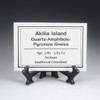
Akilia Greenland early Earth biochemistry specimen, rare Eoarchean rock
This 100-gram polished Akilia Island specimen from southwest Greenland represents a rare, tangible connection to Earth's earliest crustal environments and the long scientific search for ancient chemical traces of life. With a smooth face and guaranteed authenticity, it is a serious collector and teaching specimen for early Earth geology, astrobiology, geochemistry, and deep-time display.
Akilia Greenland Geological Context & Significance
Akilia Island, southwest Greenland, is part of one of the world's most exotic ancient crustal regions. The Akilia quartz-pyroxene rock has been studied because it preserves evidence of extremely ancient marine sedimentary chemistry from Eoarchean Earth, approximately 3.85 billion years ago (3.85 Ga).
The scientific importance of Akilia lies in its difficult but fascinating record. Researchers have debated whether carbon-bearing features in Akilia rocks represent possible biological carbon signatures, later metamorphic alteration, or a more complex combination of early sedimentation and high-grade geological overprinting. That debate is exactly what makes this specimen so valuable: it is not a simple display rock, but a physical entry point into one of the hardest questions in Earth history - when did surface chemistry become biology?
Recent potassium-isotope research supports the interpretation that Akilia quartz-pyroxene rock records a marine sedimentary origin linked to ancient seawater chemistry. This supports Akilia's place as one of the most compelling localities for studying early ocean chemistry, nutrient cycling, metamorphic preservation, and the possible geochemical boundary between prebiotic Earth and the earliest biosphere.
Akilia Early Earth Biochemistry Product Table
| Object Type | Akilia Island quartz-pyroxene rock specimen with smooth face |
| Locality | Akilia Island, southwest Greenland |
| Geological Age | Eoarchean, approximately 3.85 billion years ago; 3.85 Ga |
| Dimensions | 65 mm L x 41 mm W x 18 mm D |
| Weight | 100 grams |
| Specimen Description | Professionally prepared Akilia specimen with smooth face and back. The specimen displays a dense metamorphic mineral fabric associated with quartz-pyroxene rock and the early Earth geochemical context. |
| Scientific Significance | Akilia is one of the most important and debated early Earth localities, studied for ancient marine sedimentary chemistry, possible carbon isotope biosignatures, high-grade metamorphic preservation, and the search for Earth's earliest habitable environments. |
| Carbon Isotope Context | Reported Akilia graphite inclusions with delta 13C values near -28 per mil have been discussed as possible evidence of biological carbon fractionation. The interpretation remains scientifically important, but it is still debated because the rocks underwent intense metamorphism. |
| What Is Included | Certificate of Authenticity, scientific tag, tag stand, and information sheet titled "Akilia and Isua: Contrasting Windows into Earth's Earliest Crust." Plexiglass base and photo cube are not included. |
| Use & Display | Suitable for advanced private collections, astrobiology teaching, early Earth displays, geology classrooms, scientific interpretation, and museum-style deep-time exhibits. |
| Authentication & Compliance | Guaranteed authentic, legally obtained through a materials trade with a scientific institution, and supplied with documentation from Sciencemall-USA. |
| Shipping | Shipping calculated at checkout |
| U.S. Shipping | Free Priority Shipping within the USA |
Images professionally photographed under controlled studio lighting using Zeiss optics and a pro-grade Canon camera.
Rarity & Significance
Scientific Significance: ★★★★★
Market Availability: ⯪
Locality Importance: ★★★★★
Display Appeal: ★★★★★
This Akilia Greenland specimen is best understood as a rare early-Earth research context specimen, not as a simple decorative rock. Its value lies in its locality, age, scientific controversy, polished presentation, and its ability to connect geology, ancient oceans, carbon chemistry, and the origin-of-life question in one compact specimen.
Questions Commonly Asked About Akilia Greenland Early Earth Rocks
Does this Akilia specimen prove the earliest life on Earth?
No. Akilia is scientifically important because it has been studied in relation to ancient carbon chemistry and possible biosignatures, but the life interpretation remains debated. This specimen should be described as part of the early Earth biochemistry discussion.
What does delta 13C mean in Akilia rocks?
Delta 13C measures the ratio of carbon-13 to carbon-12 in carbon-bearing material. Life tends to favor the lighter isotope, carbon-12, so biologically processed carbon is often depleted in carbon-13. In Akilia rocks, graphite inclusions reported from apatite crystals have been discussed in relation to delta 13C values near -28 per mil, which falls within the range often associated with biological carbon fractionation. This could be evidence of ancient life, and it is one reason Akilia remains central to the debate over Earth's earliest possible biogenic carbon signatures.
Why is Akilia Greenland important?
Akilia Island is associated with some of Earth's oldest preserved crustal materials. Its quartz-pyroxene rocks have been studied for ancient marine sedimentary chemistry, carbon isotope signatures, and the environmental conditions that may have existed near the beginning of Earth's habitable surface history.
What does early Earth biochemistry mean here?
In this context, early Earth biochemistry refers to chemical signatures and sedimentary environments that may help scientists understand how carbon, oceans, minerals, nutrients, and possibly early biological processes interacted more than 3.8 billion years ago.
Is Akilia the same as Isua?
No.
Is Akilia the same as Isua?
No. Akilia and Isua are both part of the broader ancient crustal record of southwest Greenland, but they represent different geological windows into early Earth history. Isua is better known for its extensive supracrustal belt, including ancient volcanic, sedimentary, and banded iron formation units that preserve recognizable field relationships. Akilia is more restricted, more intensely metamorphosed, and more famous for its geochemical controversy - especially graphite, apatite, carbon isotope evidence, and the debate over possible early biogenic signals. In simple terms, Isua is often studied as an ancient crustal and supracrustal rock archive, while Akilia is especially important as a high-stakes geochemical test case for early Earth biochemistry.
What makes this specimen collectible?
This specimen combines extreme age, rare locality, polished presentation, guaranteed authenticity, and relevance to early Earth science. It belongs in collections focused on Earth's oldest rocks, astrobiology, geochemistry, and the origin of life.
What sets this specimen apart is not a single easy claim, but its position at the edge of what geology can still ask. Akilia compresses ancient ocean chemistry, high-grade metamorphism, the carbon-isotope debate, and the search for Earth's earliest habitable environments into a single documented specimen from southwest Greenland. For collectors who think in terms of billions of years, this is a potential, compact piece of evidence for early Earth life itself.


